
Greenhouse Condensation Prevention: A Grower's Complete Guide
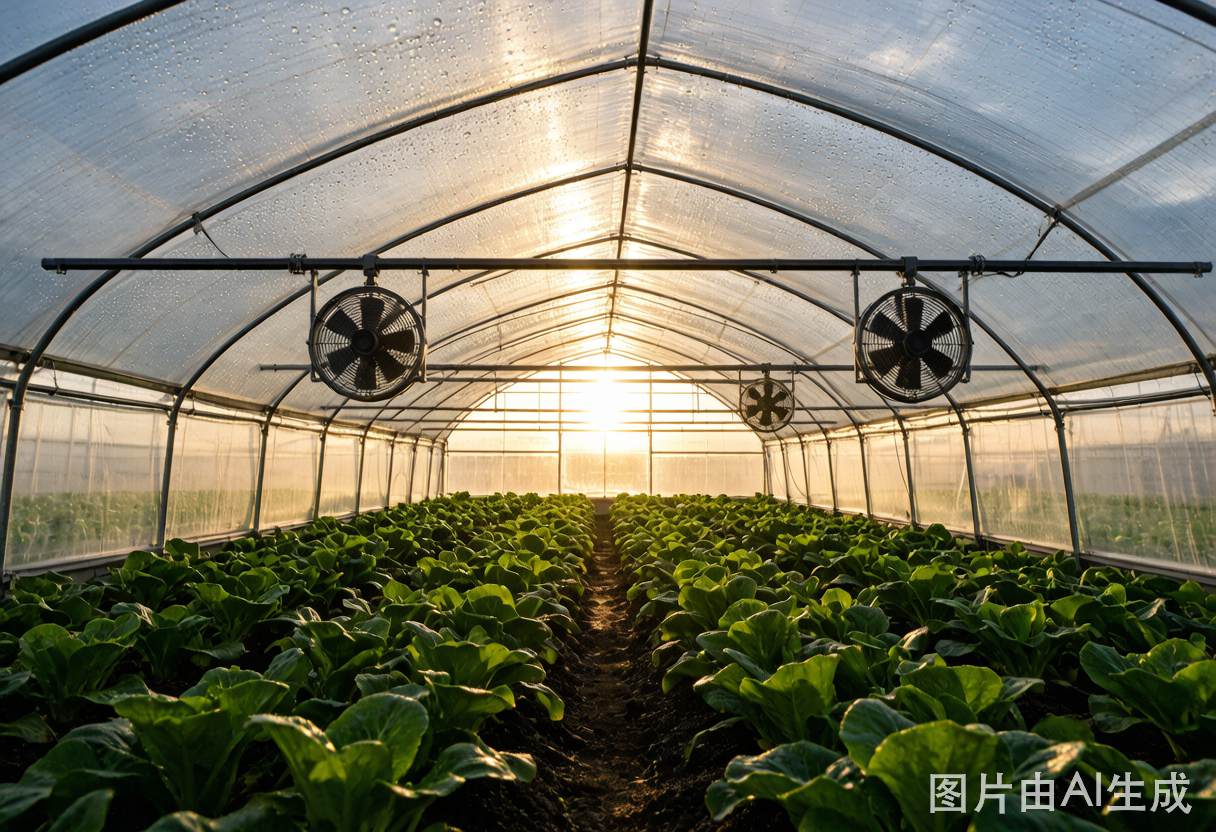
You walk into the greenhouse at dawn and the first thing you notice is water dripping from the roof rails. Droplets hang from leaf undersides. The concrete aisle is slick. By mid-morning, some lower leaves still have not dried off — and by then, the damage to your crop may already be starting.
Greenhouse condensation is not just an inconvenience. It is one of the most reliable predictors of fungal disease pressure, fruit quality loss, and wasted energy in controlled-environment agriculture. Once free moisture sits on leaf surfaces for more than a few hours, pathogens that were dormant in the crop can activate and spread faster than most sprays can stop them.
This guide explains why condensation forms, where the highest-risk zones are, and the practical systems you can put in place to keep your greenhouse dry where it matters most — at the plant canopy.
Why Greenhouse Condensation Is More Than a Nuisance
The Hidden Cost of Leaf Wetness
Every drop of condensation that lands on a leaf extends the window of time that leaf stays wet. For many greenhouse pathogens, that window is the difference between a healthy crop and an outbreak. Botrytis cinerea, the cause of gray mold, typically needs leaf wetness or very high surface humidity for several hours to germinate and infect plant tissue. Downy mildew and certain bacterial diseases follow similar rules.
The financial impact goes beyond the cost of fungicides. Condensation-related outbreaks force growers to discard infected fruit, reduce harvest frequency, and sometimes remove entire plant rows. In tomato and cucumber operations, chronic condensation pressure is consistently linked to higher incidence of blossom-end rot, cracked fruit, and secondary rotting organisms that enter through wet tissue.
Energy costs add another layer. A greenhouse that condenses moisture on its inner cover is losing heat through that same surface. The water you see dripping is latent heat leaving the building — heat you already paid for.
How Condensation Forms in Greenhouses
Condensation happens when a surface cools below the dew point of the surrounding air. The air can no longer hold all its water vapor, so the excess converts to liquid on the coolest available surface — usually the greenhouse cover, structural steel, or leaf surfaces.
In a typical growing greenhouse, three conditions drive this process:
- High humidity from crop transpiration. A fully developed tomato canopy can transpire several liters of water per square meter per day. All of that moisture enters the air above the crop.
- Temperature drops after sunset. As the cover loses heat to the night sky, its inner surface temperature falls. When it drops below the dew point of the air inside, condensation begins.
- Poor air movement. Stagnant air allows localized pockets of cool, saturated air to form against cold surfaces and around dense canopies.
The result is a greenhouse that looks fine at 3:00 PM and is dripping by 6:00 AM.
The Science Behind Condensation Risk Zones
Cold Surfaces and the Dew Point Gap
The most important number in condensation prevention is the temperature difference between the air and the coldest surface in the greenhouse. When the cover or a structural member is more than about 2–3°C below the air dew point, condensation is almost guaranteed.
This is why condensation often appears first along the gutters, sidewall connections, and anywhere metal framing touches the outside. These points have the least insulation and the fastest heat loss. A single cold gutter can produce enough dripping water to create disease pockets across several rows beneath it.
Growers can reduce this risk by understanding their cover's thermal properties. Double-layer poly films create a stagnant air gap that raises the inner surface temperature, narrowing the dew point gap. Thermal screens add another insulating layer and can reduce radiative heat loss from the crop to the cold cover at night.
Microclimates That Trap Moisture
Not all condensation is visible on the roof. Some of the most damaging condensation occurs inside the canopy itself, where leaves are cooler than the surrounding air and air movement is weakest.
Dense canopies create their own microclimate. In the center of a tomato or cucumber row, humidity can be 10–15% higher than the reading at a wall-mounted sensor. Leaves in the lower canopy may never dry completely if horizontal airflow is inadequate. These are the first places Botrytis and other moisture-loving pathogens establish.
Agronomic studies in protected cropping systems have shown that managing the boundary layer of air around leaves — the thin, still shell of humid air that clings to every leaf surface — is often more important for disease prevention than managing the bulk humidity of the whole greenhouse.
Ventilation Strategies That Actually Work
Controlled Air Exchange
Ventilation is the most direct way to remove moisture from a greenhouse. By replacing humid inside air with drier outside air, you lower the absolute humidity and raise the dew point threshold needed for condensation to form.
The challenge is doing this without crashing temperature or wasting energy. The most effective approach is controlled, gradual ventilation rather than wide-open vents. Modern greenhouses use staged vent openings — small openings first, larger openings only if humidity remains high — to purge moisture while maintaining temperature.
In winter, the incoming air is cold and dry, so even a small volume exchange can remove significant moisture. A common practice called "humidity purging" involves short ventilation bursts of 5–10 minutes to dump saturated air, followed by closing vents and allowing heating to recover temperature. This uses more energy than leaving vents closed, but far less than running the heating system flat-out to compensate for constant ventilation.
Horizontal Airflow Fans
Moving air inside the greenhouse is just as important as exchanging air with outside. Horizontal airflow fans (HAF) prevent the stagnant layers that allow condensation to form on leaf surfaces and cold structures.
A well-designed HAF system creates a slow, circular air pattern across the entire growing area. The goal is not to blast plants with wind. It is to maintain gentle, continuous air movement of approximately 0.3–0.5 meters per second at canopy level. At this speed, the humid boundary layer around leaves is constantly replaced with drier greenhouse air, which speeds evaporation and prevents droplets from forming on leaf surfaces.
Key design principles include:
- Position fans to move air in a continuous loop, not directly at plants.
- Mount fans level and slightly above the eventual canopy height.
- Run fans 24 hours per day during humid seasons, including at night when condensation risk peaks.
- Size the system to achieve at least 0.3 m/s airspeed across the entire growing area.
Many growers report that adding or improving HAF reduces morning condensation more than any other single change.
Heating and Dehumidification Tactics
Managing Temperature Gradients
Because condensation depends on surface temperature relative to air dew point, heating is a form of dehumidification. Raising air temperature without adding moisture increases the air's capacity to hold water vapor, which lowers relative humidity and raises the dew point temperature of surfaces.
Even a modest temperature increase can prevent condensation. In winter, adding 2–3°C of heat during the hours before dawn often pushes the inner cover surface above the dew point and stops dripping. The energy cost is real, but it must be weighed against the cost of disease outbreaks and lost grade-one produce.
The most efficient approach is to combine heating with ventilation. Warm air holds more moisture, so exhausting a small volume of warm, humid air and replacing it with cooler outside air can achieve a net moisture removal while maintaining acceptable temperatures.
Active Dehumidification
For high-value crops or climates where ventilation alone cannot keep up, active dehumidification becomes necessary. Industrial dehumidifiers extract water vapor from the air mechanically, giving precise control over humidity regardless of outside conditions.
The advantage of active dehumidification is control. A properly sized unit can hold relative humidity at a setpoint — for example, 75% RH at night — rather than reacting to weather. This is especially valuable in:
- Cold climates where outside air is too cold to ventilate in winter.
- Humid regions where outside air is nearly as wet as inside air.
- Crops with narrow humidity windows, such as cannabis, orchids, or propagation houses.
Sizing matters. An undersized dehumidifier will run continuously without reaching setpoint, while an oversized unit will short-cycle and create temperature swings. A reasonable starting point is to calculate the peak moisture load from transpiration and irrigation evaporation, then add a safety margin of 20–30%.
Structural and Operational Fixes
Covering Materials and Anti-Drip Films
The surface where condensation first forms is usually the greenhouse cover. Choosing the right covering material and maintaining it properly can eliminate a major source of dripping.
Anti-drip films contain additives that change the surface tension of water, causing condensation to form a thin, even sheet instead of large droplets. The sheet runs down the slope to the gutters rather than dripping onto the crop. This does not remove moisture from the greenhouse, but it directs it to collection points where it cannot cause disease.
Condensation also forms more readily on dirty covers. Dust, algae, and deposits on the inner surface create nucleation points for droplets and reduce light transmission. Regular cleaning of both the inside and outside of the cover improves light levels and reduces uneven condensation patterns.
Thermal insulation improvements such as double poly, inflated roofs, and retractable thermal screens reduce heat loss through the cover. This raises the inner surface temperature and shrinks the dew point gap. Thermal screens alone can cut nighttime heat loss by 20–40%, which indirectly reduces condensation by keeping the cover warmer.
Irrigation Timing and Canopy Management
How and when you water has a direct effect on nighttime humidity. Irrigation events raise humidity for hours afterward, and late irrigation means the greenhouse enters the night with more moisture in the air than necessary.
Best practices for condensation prevention include:
- Complete the last irrigation cycle 2–3 hours before sunset when possible.
- Use drip irrigation instead of overhead systems to minimize evaporation from the floor and leaf surfaces.
- Avoid over-irrigating, especially on cloudy days when transpiration is low.
- Manage canopy density through pruning and leaf removal to improve air movement through the crop.
Leaf removal in the lower canopy is particularly valuable. Older lower leaves transpire less but trap moisture. Removing them improves airflow and removes tissue that is most vulnerable to Botrytis and other condensation-related diseases.
Build a Condensation Prevention Routine
Greenhouse condensation prevention works best as a daily discipline, not a reaction to visible dripping. Here is a practical routine that integrates the strategies in this guide:
- Morning check. Walk the greenhouse at first light. Note where condensation formed overnight — gutters, sidewalls, or inside the canopy. These are your priority zones.
- Sensor review. Confirm that canopy-level relative humidity stayed below your night target, typically 80–85% for most vegetable crops.
- Ventilation plan. Check the weather forecast and plan humidity purging for high-risk periods.
- Irrigation schedule. Avoid late watering. Shift final irrigation earlier on cold or cloudy days.
- Equipment check. Verify HAF fans, vents, heating systems, and dehumidifiers are operating as intended.
By tracking which zones condense and under what conditions, you build a greenhouse-specific playbook. What works in a dry continental climate will differ from what works in a humid coastal region, but the underlying principles remain the same.
Frequently Asked Questions
What humidity level causes condensation in a greenhouse?
Condensation does not depend on relative humidity alone. It depends on whether a surface is colder than the dew point of the surrounding air. However, once relative humidity exceeds 85% and temperatures fall overnight, condensation becomes very likely on cooler surfaces such as the cover, framing, and leaf edges. Most growers aim to keep nighttime RH below 80–85% to provide a safety margin.
Can condensation damage plants directly, or is it only a disease risk?
Condensation damages plants both directly and indirectly. Directly, large droplets falling from the roof can bruise fruit, spread soil-borne pathogens, and cause physical spotting on leaves. Indirectly, and more importantly, leaf wetness from condensation creates the conditions fungal and bacterial pathogens need to infect tissue. Even without visible disease, repeated wet-dry cycles weaken leaf cuticles and reduce overall plant vigor.
Do anti-drip films actually prevent condensation?
Anti-drip films do not prevent condensation from forming, but they change how it behaves. Instead of beading into large drops that fall onto the crop, condensation forms a continuous water film that drains down the cover to the gutters. This keeps moisture away from plants and reduces the risk of localized disease pockets. For best results, anti-drip films should be paired with ventilation or dehumidification to actually remove moisture from the air.
How much ventilation does a greenhouse need to control condensation?
There is no single number because ventilation needs depend on crop transpiration rate, outside weather, and greenhouse design. As a general guideline, greenhouses need at least one to two full air changes per hour to maintain reasonable humidity levels in a transpiring crop. In practice, most growers use humidity-triggered vent controls that open enough to hold RH near the setpoint rather than running at a fixed ventilation rate.
Is heating or dehumidification better for condensation prevention?
Both have a role. Heating prevents condensation by raising air temperature and surface temperatures, which keeps the cover above the dew point. It is fast and effective but can be energy-intensive. Dehumidification removes moisture directly and gives precise humidity control, but it requires capital investment. The best approach for most operations is a combination: controlled ventilation to purge humid air, strategic heating during high-risk night hours, and dehumidification when outside air is too wet or cold to ventilate economically.
Need Help with Climate Control?
Get a free consultation from our application engineering team for your specific growing environment.
Contact an Engineer