
Mushroom Growing Humidity Control: The Complete Guide to Maximizing Yield and Preventing Crop Loss
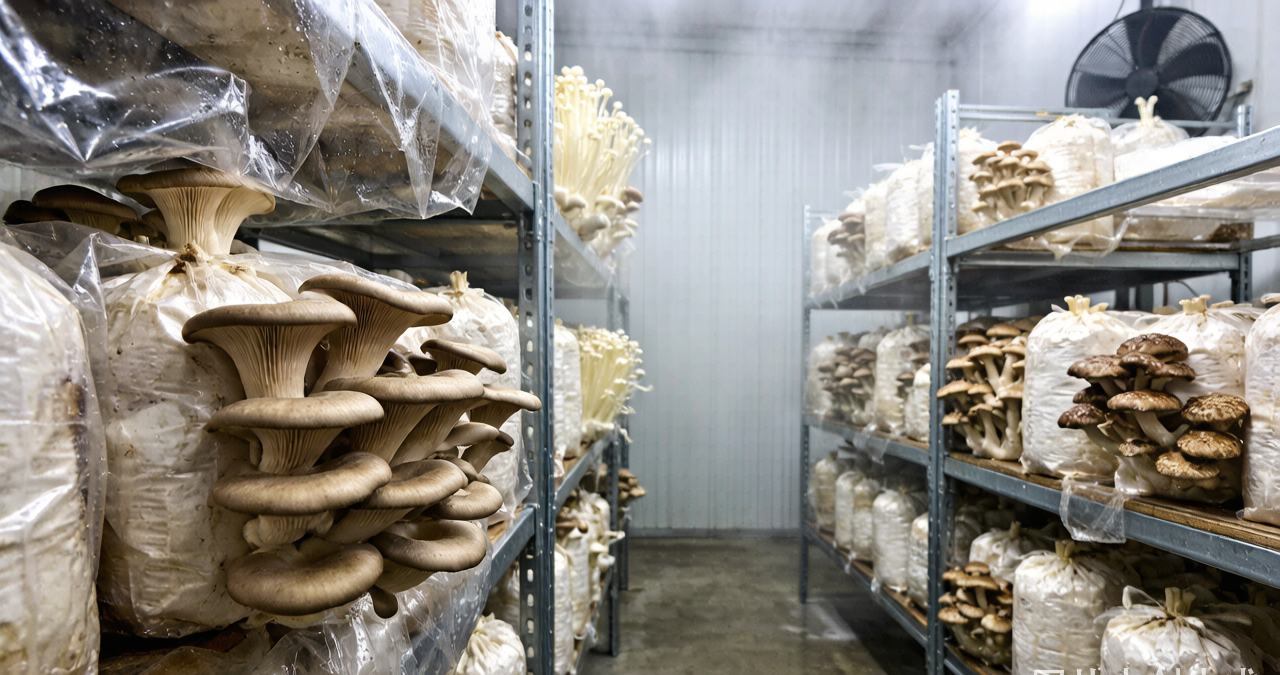
If you grow mushrooms commercially, you already know: humidity is not a secondary variable — it is the single most critical climate parameter determining whether your crop thrives or fails. Unlike green plants that regulate moisture through stomata, mushroom fruiting bodies are exposed entirely to ambient air. They are 85–95% water by weight. When the air is too dry, they lose moisture faster than mycelium can supply it. When the air is too wet, competitor molds and bacterial diseases take over.
Effective mushroom growing humidity control is what separates a 15% biological efficiency operation from one hitting 100%+. Whether you are a small-scale grower with a converted shipping container or a commercial operation running multiple mushroom grow rooms, understanding and managing humidity at every growth stage is the foundation of profitable yields.
This guide breaks down exactly what humidity levels each mushroom species needs, what goes wrong when those levels are off, and how to build a humidity control system that works for your scale — from natural cultivation to fully automated smart greenhouses.
Optimal Humidity Parameters by Mushroom Type and Growth Stage
Different mushroom species have distinct humidity requirements across three phases: spawn run (mycelial colonization), pinning (primordia formation), and fruiting (maturation). Getting these numbers right is the core of mushroom room humidity management.
| Mushroom Type | Spawn Run RH | Pinning RH | Fruiting RH | CO₂ Sensitivity |
|---|---|---|---|---|
| Oyster (Pleurotus) | 80–85% | 90–95% | 85–92% | High |
| Shiitake (Lentinula) | 60–70% | 85–90% | 80–85% | Medium |
| Enoki (Flammulina) | 70–75% | 90–95% | 85–90% | Very High |
| King Oyster (P. eryngii) | 70–75% | 90–95% | 85–90% | High |
| Button (Agaricus) | 70–75% | 95–98% | 85–90% | Medium |
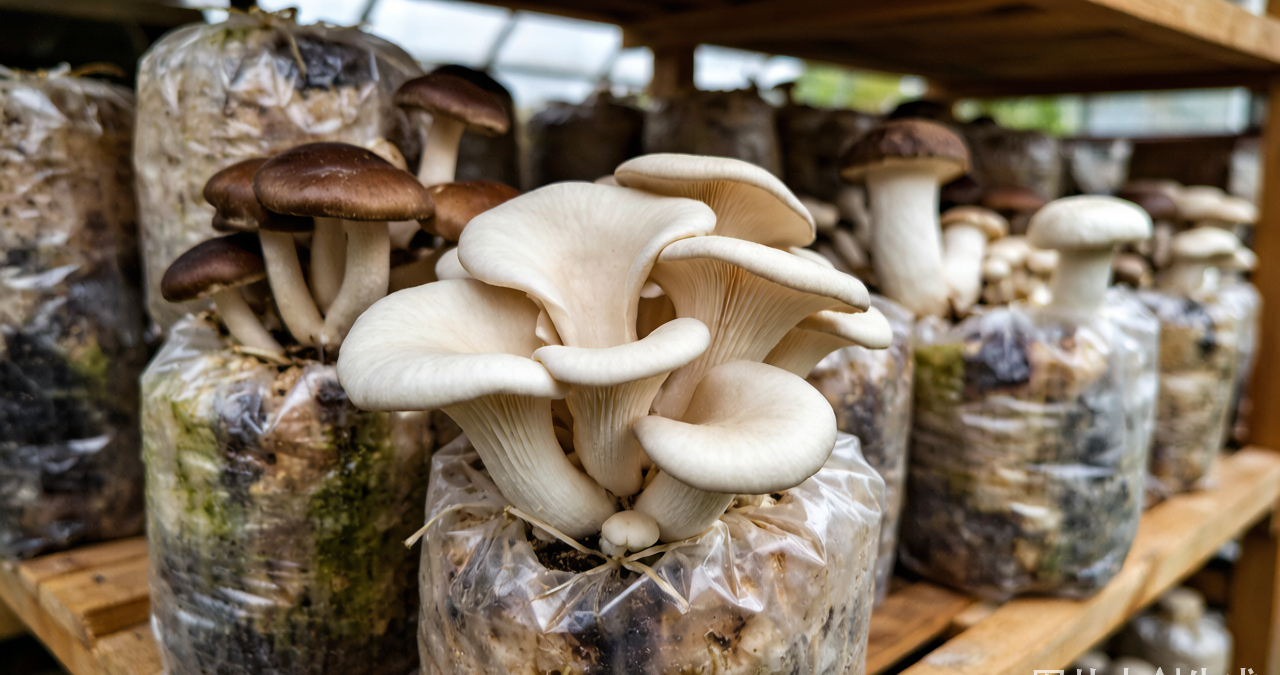
Key takeaways from this table:
- Pinning requires the highest humidity (90–98% RH). This is when primordia form — if the air dries out during this 3–5 day window, pins abort and will not recover.
- Spawn run needs the lowest humidity. Excess moisture during colonization encourages Trichoderma green mold and wet-spot bacteria.
- Fruiting RH is species-dependent but generally falls between 80–92%. The goal is high enough to support fruit body expansion, but not so high that condensation drips onto caps.
For commercial mushroom farming humidity management, the most common mistake is running a single RH setpoint throughout the entire cycle. A proper mushroom grow room climate control system must support stage-based scheduling — automatically shifting from 75% during spawn run to 95% during pinning, then back to 85% for fruiting.
What Happens When Humidity Goes Wrong
Humidity Too Low: Cracked Caps, Stunted Growth, and Aborts
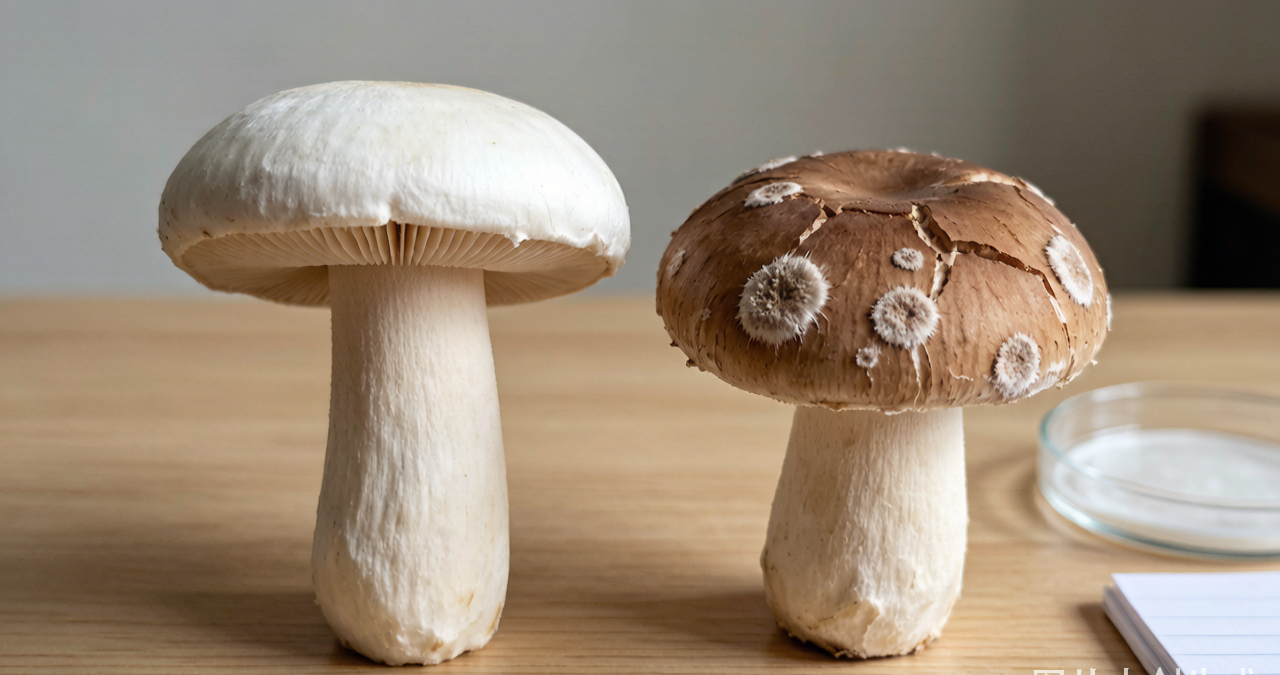
When RH drops below 80% during fruiting, mushrooms lose water to the air faster than they can absorb it from the substrate. The visible symptoms are unmistakable:
- Cracked and split caps — the outer tissue dries and tears as the mushroom tries to expand
- Stunted fruiting bodies — mushrooms remain small and lightweight, reducing harvest weight by 30–50%
- Pin aborts — primordia form but stop developing and brown off within 24–48 hours
- Dry, fibrous stems — commercial quality drops, and mushrooms become unsellable
For growers selling by weight, even a 10% RH deviation below optimal can translate to a 20–30% yield reduction. Mushroom yield improvement by humidity control is not theoretical — it is direct, measurable, and immediate.
Humidity Too High: Disease, Contamination, and Crop Loss
Paradoxically, too much humidity is even more dangerous. When RH exceeds 95% for extended periods, or when condensation forms on surfaces:
- Bacterial blotch (Pseudomonas tolaasii) — brown, slimy lesions on mushroom caps; the #1 quality defect in button mushroom production
- Trichoderma green mold — a fast-growing competitor that colonizes substrate and crowds out cultivated mycelium
- Cobweb mold (Cladobotryum) — fluffy white-to-gray growth on mushrooms and casing soil that renders the crop unsellable
- Soft rot and decomposition — excess surface moisture breaks down fruit body tissue within hours
The critical insight: high humidity itself is not the enemy — stagnant, condensing humidity is. The solution is maintaining high RH with simultaneous air exchange. A well-designed greenhouse humidity control for mushroom cultivation system pairs humidification with fresh air exchange to keep RH high without surface wetness.
Three Humidity Control Scenarios: From Natural to Smart Greenhouse
1. Natural / Traditional Cultivation
In outdoor or semi-outdoor mushroom beds, humidity depends entirely on weather and manual misting. This works for low-volume, seasonal production but cannot support consistent commercial yields. Growers rely on shade cloth, ground wetting, and hand misting — effective only when ambient humidity is naturally high (70%+).
2. Simple Grow Room (Converted Space)
A sealed room with basic humidifiers and exhaust fans is the entry point for most commercial growers. Ultrasonic humidifiers connected to a hygrostat can maintain 80–90% RH. However, these setups lack precision — humidity swings of ±10% are common, and there is no coordinated fresh air exchange. Contamination rates tend to be higher because stagnant humid air promotes mold.
3. Standardized Smart Mushroom Greenhouse
A purpose-built mushroom greenhouse with integrated mushroom grow room climate control represents the professional standard. These systems combine:
- Ultrasonic or high-pressure fog humidifiers for fine mist that evaporates before reaching surfaces
- Industrial dehumidifiers to pull moisture back during flush transitions or when ambient RH spikes
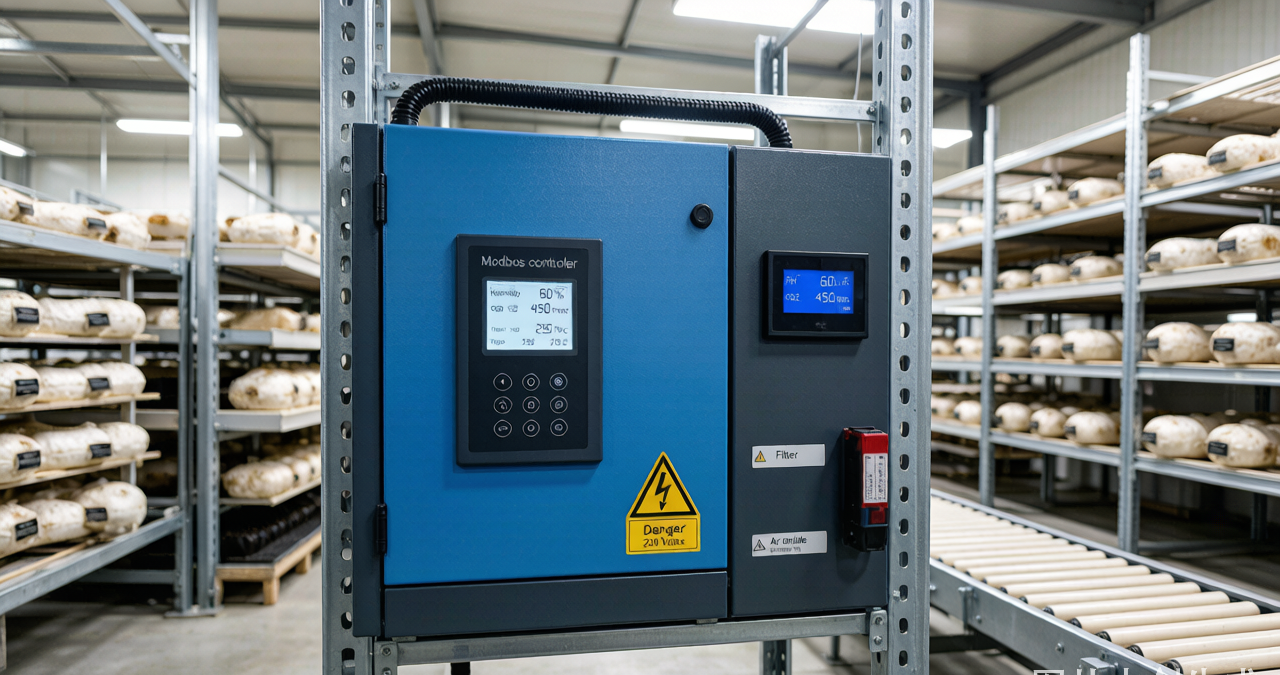
- Smart controllers with Modbus/RS485 for stage-based RH scheduling and remote monitoring
- Synchronized fresh air exchange — CO₂ extraction and humidification run in coordinated cycles
This is where mushroom plantation greenhouse construction meets climate engineering. The greenhouse is designed around the mushroom's biological schedule, not the other way around.
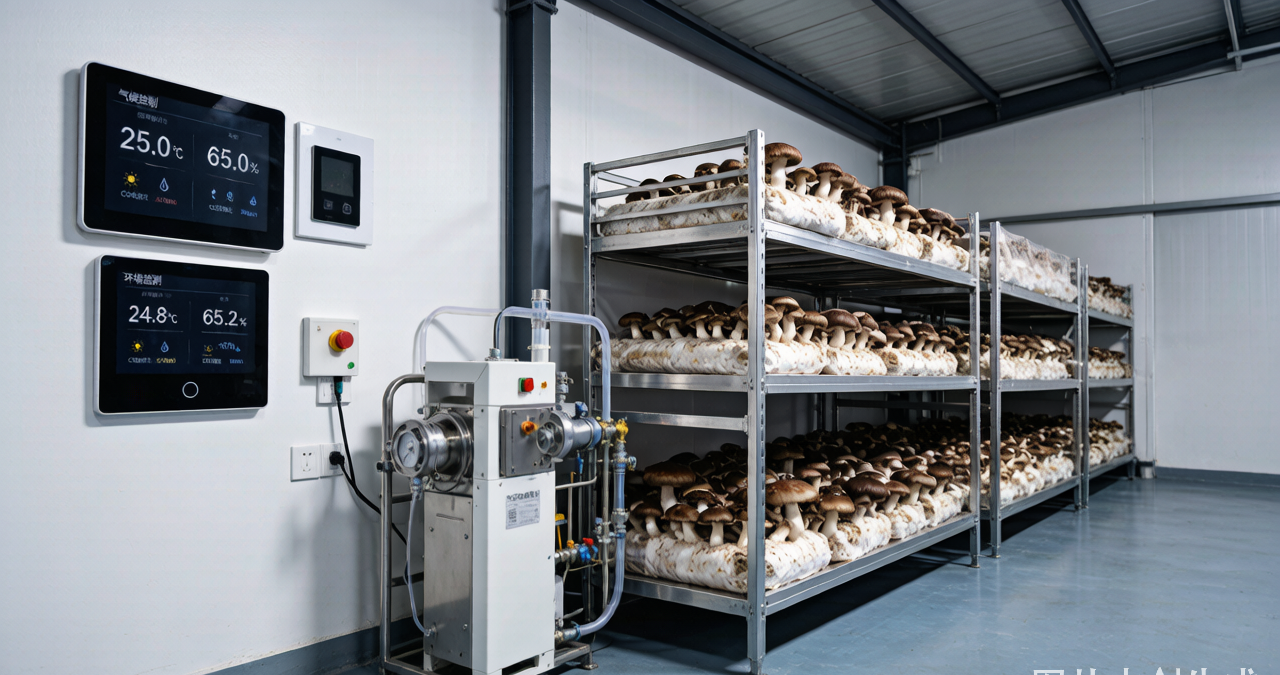
Building a Mushroom-Specific Greenhouse Climate System
For greenhouse construction clients and engineering firms, mushroom cultivation has unique design requirements that differ significantly from plant-based greenhouses:
- Insulation and vapor barriers: Mushroom houses operate at 85–95% RH continuously. Without proper vapor barriers in walls, ceilings, and floors, moisture migrates into the structure, causing rot and thermal loss. Closed-cell insulation (minimum R-15) with sealed vapor barriers is non-negotiable.
- Air exchange without humidity loss: Mushrooms need 4–10 air changes per hour (species-dependent) to flush CO₂, but every air change brings in drier outside air. A heat recovery ventilator (HRV) with an integrated humidification loop solves this — exchanging air while recapturing moisture and heat.
- Zoned climate control: Commercial operations run multiple grow rooms at different growth stages simultaneously. Each room needs independent humidity, temperature, and CO₂ control. A central PLC or BMS with Modbus RTU communication can manage 4–16 zones from a single interface.
- Drainage and condensate management: At 95% RH, condensation is inevitable. Floors must slope to drains, walls must be washable and non-porous, and ceiling condensation must be captured or directed away from crops.
For agricultural climate distributor partners, these design requirements translate directly into equipment specifications — the right humidifier capacity, dehumidifier sizing, controller type, and sensor package for each project.
Smart Humidity Equipment: Advantages and Distributor Value
Modern mushroom climate systems have moved far beyond on/off humidistats. Today's professional equipment offers:
- PID-controlled ultrasonic humidification — maintains RH within ±2% instead of the ±10% swings of basic systems
- Remote monitoring via Modbus 485 — growers can check and adjust room conditions from a phone, and integrate with existing farm management software
- Dual-mode operation — a single system can humidify during pinning and dehumidify during flush transitions, eliminating the need for separate equipment
- Data logging and yield correlation — track RH, temperature, and CO₂ against harvest weight to optimize your recipe over time
For distributors serving the mushroom cultivation market, these features create clear differentiation. Growers who upgrade from basic humidistats to smart controllers typically see 15–25% yield improvements within the first cycle — a compelling ROI story that drives repeat purchases and referrals.
Common Mistakes and Practical Tips
- Mistake 1: Misting directly on mushrooms. Water droplets on caps cause bacterial blotch within hours. Use ultrasonic or fog humidifiers that produce mist fine enough to evaporate before contact.
- Mistake 2: One setpoint for the whole cycle. Mushrooms need different RH at each stage. Program your controller to shift automatically — 75% spawn run, 95% pinning, 85% fruiting.
- Mistake 3: Ignoring CO₂ when managing humidity. Humidification and air exchange are linked. When you run fresh air to reduce CO₂, you lose humidity. Coordinate both with a smart controller, not separate timers.
- Mistake 4: No dehumidification capacity. Many growers install humidifiers but no dehumidifiers. When ambient humidity spikes or a flush ends, you need to pull moisture out fast. A closed-loop system with both is the professional standard.
- Practical tip: Place humidity sensors at canopy height, not on the wall. A 5% RH difference between wall-mounted sensors and actual mushroom-level conditions is common — and enough to cause problems during pinning.
Conclusion
Mushroom growing humidity control is not about keeping things "damp." It is about maintaining species-specific, stage-specific RH ranges with precision — high enough to support fruit body development, controlled enough to prevent disease, and coordinated with air exchange to manage CO₂.
Whether you are a grower looking to increase yields, a greenhouse builder designing a mushroom facility, or an agricultural climate distributor sourcing equipment for clients, the principle is the same: the right humidity system is the highest-ROI investment in mushroom cultivation.
Ready to design a humidity control system for your mushroom operation?
Contact our engineering team for a free consultation, or explore our industrial dehumidifiers and ultrasonic humidifiers designed for commercial mushroom cultivation.
Need Help with Climate Control?
Get a free consultation from our application engineering team for your specific growing environment.
Contact an Engineer